


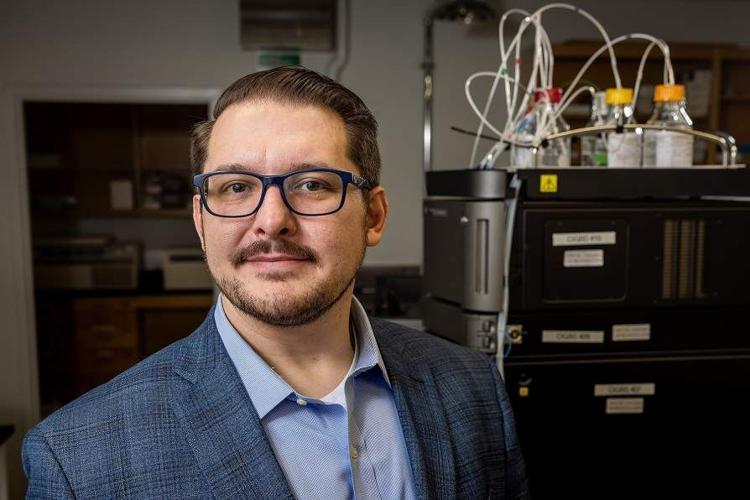
Nicholas Smith, assistant professor and director of graduate studies in the Division of Clinical and Translational Therapeutics at the University at Buffalo School of Pharmacy and Pharmaceutical Sciences, is working with a new $9.5 million Center for Phage Pharmaceuticals at Stanford University focused on fighting antibiotic-resistant infections in patients with cystic fibrosis.
UB pharmacy professor working with researchers at NIH-funded center at Stanford
“Phages work in a dish. In patients, results have been wildly inconsistent and these centers are designed to better dose and deliver them.”
Nicholas Smith, assistant professor and director of graduate studies
Division of Clinical and Translational Therapeutics, School of Pharmacy and Pharmaceutical Sciences.
BUFFALO, N.Y. — The genetic disease cystic fibrosis (CF) causes the lungs to fill with mucus, which provides the perfect breeding ground for bacteria and infections.
People are also reading…
“Over the past 15 years, treatment of cystic fibrosis has improved dramatically, but patients are still at high risk for getting infections,” says Nicholas Smith, PharmD, PhD, assistant professor and director of graduate studies in the Division of Clinical and Translational Therapeutics at the University at Buffalo School of Pharmacy and Pharmaceutical Sciences.
As patients with cystic fibrosis age, their infections become increasingly resistant to treatment, which can threaten their lives, Smith says. The problem is exacerbated by the growing rate of antibiotic resistance, which reduces the number of reliable antibiotics.
Beginning this summer, Smith will get the chance to tackle this problem. He is working with a new $9.5 million Center for Phage Pharmaceuticals at Stanford University, which is focusing on fighting antibiotic-resistant infections in CF patients.
The National Institute of Allergy and Infectious Diseases (NIAID) is funding three Centers for Accelerating Phage Therapy to Combat ESKAPE Pathogens (CAPT-CEP). This includes the Center for Phage Pharmaceuticals at Stanford led by Paul Bollyky, MD, DPhil, professor and chief of the Division of Infectious Diseases and Geographic Medicine at Stanford.
Researchers at all three centers are looking at the seemingly intractable problem of drug resistance from different perspectives through bacteriophages (phages), a type of virus that selectively targets and destroys bacteria from within.
“Phages offer a promising solution, but clinical outcomes have been mixed and need to be made more reliable and predictable,” Smith says.
Critical research for pressing challenge
The other two centers are the Center for PhAIge Therapy at Gladstone Institutes, an independent science research organization in San Francisco, and the Pitt Center for Accelerating Phage Therapy at the University of Pittsburgh. This marks the first coordinated U.S. research network dedicated to building the preclinical tools, assays and models needed to translate phage therapy into a reliable treatment for antibiotic-resistant infections.
“Antimicrobial resistance remains one of the most pressing challenges in health care today, making innovative approaches to treating drug-resistant infections more important than ever,” says Gary Pollack, PhD, dean of the UB School of Pharmacy and Pharmaceutical Sciences. “Dr. Smith’s role in the Center for Phage Pharmaceuticals reflects both the impact of his research and the vital contributions our faculty members are making to advance innovative treatments for patients with a variety of disorders, including difficult-to-treat infections.”
The ESKAPE pathogens — Enterococcus faecium, Staphylococcus aureus, Klebsiella pneumoniae, Acinetobacter baumannii, Pseudomonas aeruginosa, and Enterobacter species — drive the majority of multidrug-resistant infections in hospitals. Antimicrobial resistance is associated with nearly 5 million deaths worldwide each year, a toll the World Health Organization projects could reach 10 million per year by 2050.
“Phages work in a dish. In patients, results have been wildly inconsistent and these centers are designed to better dose and deliver them,” says Smith. “The basic pharmacokinetics and pharmacodynamics (PK/PD) has barely been studied. That’s what our Center for Phage Pharmaceuticals is built to fix.”
Smith sharing his expertise in PK/PD
The Stanford center researchers will integrate nuclear medicine imaging with advanced cell culture and animal models to study and optimize respiratory phage delivery, beginning with Pseudomonas aeruginosa infections in CF.
Smith will serve as principal investigator for “Project 1: Nuclear Imaging and Phage Pharmacokinetics” and “Core C: Phage Pharmacology & Modelling Core.”
Smith, an international expert in mathematical modeling to combat emerging resistance mechanisms, was awarded a $3.6 million research grant in 2024 from the NIAID for his project, “Pharmacokinetics and Pharmacodynamics (PK/PD) of Mechanistically Aware Phage Cocktails.”
For this upcoming project, he will develop advanced mathematical models that can predict how phages work for infection treatment in the real world.
“We’ll be focusing on PK/PD, which is the bread and butter of our work at UB,” Smith says. “We’ll look at the dosage we give to patients in the right amount to reach the infection site.”
Along with Smith, the Stanford center team includes nine Stanford investigators and one from the University of Alabama at Birmingham.
In August, researchers from the three centers will convene at NIH headquarters in Bethesda, Maryland, to kick off the research that extends over five years.
“This is a very interdisciplinary grant and I’m excited for its impact on improving patient health,” Smith says. “These efforts are entirely owed to the fantastic team we are working with here in Buffalo and across the country.”


