




BUFFALO, N.Y. – To create a single point of contact to support all artificial intelligence activities across the University at Buffalo, the UB Office of Research, Innovation and Economic Development (RIED) has established the Office of AI Innovation and Integration.
The purpose of the office is to connect people and ideas, help guide projects from concept to implementation, and ensure responsible use of AI through best practices aligned with university goals.
“There is no department or unit that is untouched by AI,” says Venu Govindaraju, senior vice president for research, innovation and economic development. “This is a unique opportunity for us to shape and improve efficient access to AI across the university.”
Four primary focus areas
People are also reading…
The office will serve four primary focus areas:
- Academic – Support the use of AI in teaching, learning and student support.
- Research – Strengthen AI-driven research, innovation and industry collaboration.
- Operations – Improve how the university works using AI across administrative areas.
- Economic development and commercialization – Drive transformative AI impact across industry, market and community.
The office will also serve as a conduit for the most up-to-date regulations and guidelines established by SUNY covering AI use, ethics and intellectual property protection; for best practices to manage risks related to data, privacy and security; and for reporting standards required by federal, state and private research funding sources.
Leadership and expertise
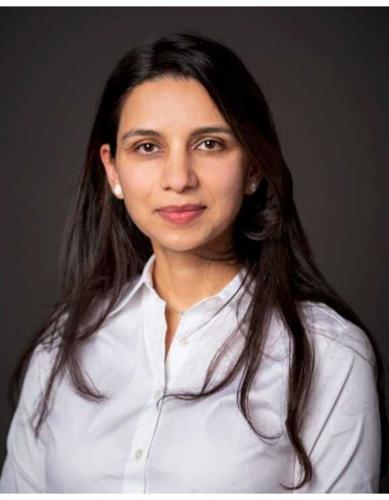
Neeti Pokhriyal, who received her PhD in computer science from UB in 2019, will serve as director, leading the launch, strategic visioning and early activities of the office to coordinate AI resources, needs and opportunities across UB research, academics and industry partnerships.
Pokhriyal is a computer scientist with expertise in policy-relevant research related to the responsible design of AI in critical contexts of national security and societal well-being. Previously, she led studies and analytical work leveraging AI for national security at the RAND Corporation in Washington, D.C. She has received prestigious policy fellowships, including the AAAS Science and Technology Policy fellow (STPF) (2022), and Mirzayan Policy Fellow at the National Academies of Sciences, Engineering, and Medicine (2022).
As an AAAS STP fellow, she contributed to the National Science Foundation's National AI Research Institutes program and was on the leadership team of the ExpandAI program. She completed her postdoctoral research at Dartmouth College and was awarded the Chih Foundation Research Award while a UB student.
“I’m looking forward to leading data-driven work from idea to implementation that will positively impact our campus and communities,” says Pokhriyal. “AI touches all of our lives, and the potential for good is immense.”
Campuswide collaboration
Pokhriyal will be supported by team of liaison fellows from the UB community, a vibrant and collaborative group representing academic, operations and administrative units. The fellows will help identify and drive opportunities for AI innovation in their respective areas across campus by identifying needs, prioritizing projects, supporting pilots, ensuring alignment, determining high-impact use cases, sharing outcomes and disseminating best practices.
Four senior leaders serve as an advisory committee to the Office of AI Innovation and Integration: Heath Tuttle, vice president and chief information officer (VPCIO); Laura Hubbard, vice president, finance and administration; Graham Hammill, senior vice provost for academic affairs; and Associate Provost Bill McDonnell.
An advisory working group of faculty, staff and students will also lend valuable perspectives to shape the organization’s efforts moving forward.
“This approach allows for organic growth of AI across the university, where challenges and solutions are contributed by a broad cohort of users rather than handed from the top down,” explains Govindaraju. “Having one single point of contact ensures efficient use of expertise and resources, including Empire AI, and provides us all a birds-eye view of the incredible potential AI has to shape research and education at UB.”


