
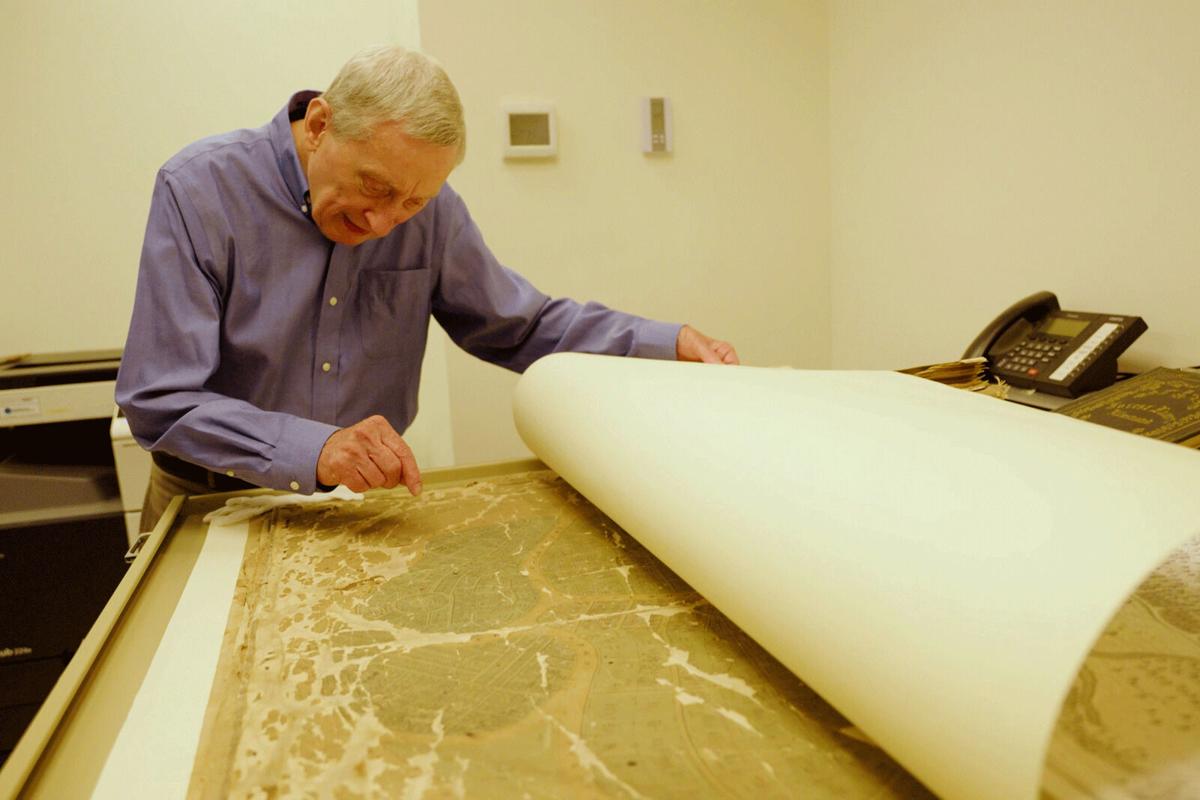
Forest Lawn Archivist John Edens talks with CEO Julie Snyder about how he manages 170+ years of history at Forest Lawn Cemetery. With new discoveries made daily, the Margaret L. Wendt Archive and Resource Center provides a home for our ever-growing archives. Do you have a piece of Forest Lawn history? Contact us about archival materials.
It might seem obvious that a historic cemetery deals with a lot of, well, history. But what might surprise you is how that history is always evolving.
At Forest Lawn Cemetery, records and archival materials are housed in the Margaret L. Wendt Archive and Resource Center and maintained by archivist John Edens, who has worked at Forest Lawn since 2013. His first project was to organize the records having to do with the cemetery’s establishment in 1849 and its administration, governance and development.
“All of those things had been ignored,” he says. “They were everywhere in the administration building—they were in vaults, in drawers, in boxes.”
Now thanks to Edens’ work, all the cemetery records—from founding documents and historical maps to burial and plot ownership information for the more than 170,000 people buried or entombed there—are organized and housed in a state-of-the-art facility that features humidity and temperature control and archival-quality storage containers to help ensure their preservation.
The records are available for anyone to peruse and go back 175 years, including the first deed when the original 80 acres were purchased and a document known as the Death Register, which lists the earliest burials and information about the deceased.
“For some people, that might be the only record we have,” Edens says. “That person may not have a monument on his or her grave, so what’s in that Death Register really tells it all.”
All of this meticulous record-keeping is a continuing process—new records are created every day as someone is buried or buys a plot. However, additional historical information is also unearthed on a regular basis, filling in the gaps on people who have been buried there for decades.
“We know a lot about some of them—they’re very well-known names,” Edens says. “We know somewhat about others. But there are many, many thousands we know nothing about.”
Edens shared one recent research win. While looking into pioneering mystery writer and Forest Lawn resident Anna Katherine Green, he came upon a 1932 Buffalo Evening News article about noteworthy Buffalo women who were going to be featured in a book. The article mentioned an Elizabeth Dickinson, and out of curiosity, Edens checked—and she too turned out to be buried in Forest Lawn.
All the cemetery had listed was that she was a widow who had died on Dec. 24, 1931, and was buried in the Dickinson plot. “But there’s much more to this woman,” Edens says.
Through additional research, he discovered that Dickinson immigrated to Buffalo from Germany at age 12. At 18, she married her husband Thomas, whose family owned the oldest jewelry store in Buffalo.
“She immediately got involved in the business—she had all these ideas,” Edens says. “They expanded the business thanks to her ideas; they had to move twice.”
Thomas died in 1896. Elizabeth ran the business for another 30 years and became one of the nation’s top diamond experts.
Her obituary called her “a feminist for 75 years” and quoted her as believing that if a woman “was capable of working and having a profession, she should do that rather than stay at home.”
“It’s just one of 170,000-plus stories,” says Forest Lawn CEO Julie Snyder.
For more fascinating stories and information on what you can find in the Forest Lawn archives, check out the podcast linked at the beginning of this article.