



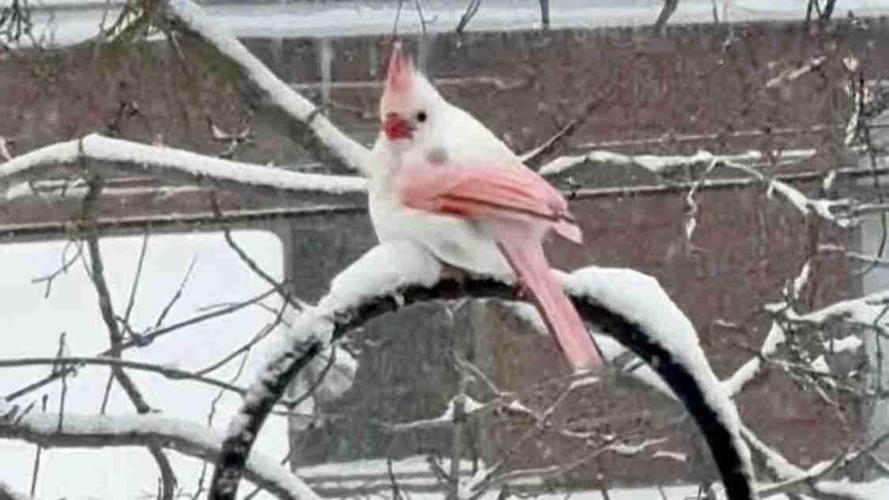
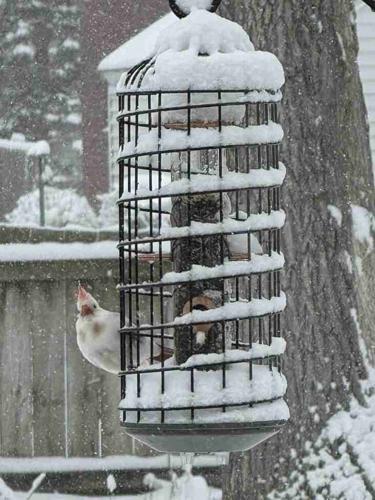
It is not every day that a backyard bird feeder delivers something truly extraordinary. But that is exactly what happened for Lynn Westcott, Director of Development at Buffalo Audubon Society, when a striking and unusually pale Northern Cardinal appeared at her Snyder, NY, home on January 15.
The bird, identified shortly after by Buffalo Audubon Senior Naturalist Tom Kerr, is leucistic, meaning it carries a genetic condition that causes a partial loss of color pigmentation in its feathers. The result is a ghostly, eye-catching variation on the familiar red cardinal most Western New Yorkers recognize at a glance. The sighting has since been shared by the National Audubon Society on Instagram, drawing attention well beyond WNY.
“My feeders are up year-round, but I never expected to see such a rare bird in my own backyard. It really was beautiful,” said Westcott. “What has been equally meaningful has been the outpouring of enthusiasm from people all over Western New York and beyond who have had the chance to share in the sighting and be excited about birding in general.”
People are also reading…
Leucism is distinct from albinism, which causes a complete absence of melanin and results in an all-white animal. With leucism, only some pigmentation is lost. Interestingly, the condition primarily affects melanin, the pigment responsible for black, brown, gray, and buff tones in feathers, while leaving carotenoid pigments — which produce red and yellow — largely intact. That distinction actually helps experts identify whether a leucistic cardinal is male or female. On this particular bird, the areas that would normally appear brown or buff have been replaced with white, while the crest, wings, and tail retain their reddish color — the telltale pattern of a female.
The timing of the sighting is a good reminder of what winter birding in Buffalo can offer. Northern Cardinals are among the species that stay put through the cold months rather than migrating, alongside Blue Jays and Dark-eyed Juncos. They survive by fluffing their feathers for insulation, regulating body heat internally, seeking shelter, and ramping up their food intake — sometimes even caching food in locations they can remember for months.
Tom Kerr sees the sighting as an invitation. “This is just an example of what can happen when you leave your feeders up year-round,” he said. “We’d really encourage it. Doing so not only helps us have these unique sightings, but it also helps birds survive the long winter months.”
You can view photos and video of the leucistic cardinal via Buffalo Audubon’s Instagram post, which has been drawing fans from across the country. For more on how winter birds survive the season, including a deeper dive into the biology and behaviors that keep them going through a Buffalo winter, check out Buffalo Audubon’s blog post. And for a look at the winter survival tips Buffalo Audubon recently shared, the second Instagram post is worth a scroll too.


