
Scott Kessler, executive vice president and chief information officer at Tops Markets parent company Northeast Grocery, has been at the forefront of retail innovation during his more than 25-year career.
At Northeast, he leads the information technology program for both Tops and its sister chain Price Chopper/Market 32, where technology is helping the company bring both regional brands to a higher standard.
"We're using (artificial intelligence) as a kind of a bridging strategy, because we have merged two brands, and as a part of merging our systems, we have a lot of consolidation work," Kessler said.
"What (generative) AI and robotics is enabling us to do is kind of have a bridging strategy so that, as we're doing that modernization of our core systems to elevate our performance, it really helps us compete with our competitors that are faster and quicker and have more modern systems," he said.
People are also reading…
Tops was a trailblazer with its BonusCard program, and it has continued to innovate over the years with things like its Shop and Scan technology, which lets shoppers scan their purchases as they shop and check out via their mobile phones.
It also has sophisticated fraud and theft management programs, such as its ability to see whether customers have left items under their carts without paying for them; and now its robotic inventory management tool called Tally Robot, which aggregates data to keep track of stock and pricing on shelves.

Scott Kessler, executive vice president and chief information officer for Northeast Grocery, says technology and AI are helping Tops and Price Chopper/Market 32 modernize.
Kessler talked about the cutting edge of grocery retail.
Q: Tell me about Tally Robot.
A: That's an AI platform. It uses computer vision and advanced artificial intelligence technologies to really allow us to do some some new things throughout the store.
Online, you know everything that a person's doing because they click and there's a digital trail in the store. There's a data desert in the store where you know product that goes into the store, you know sales that leave the store, because you have a point of sale system, but you really don't know what's happening throughout the day.
So you require a lot of personnel to tell you what's going on, and that's not always fast and accurate, and definitely not − when you try to aggregate it up and make business decisions − the best method.
So now what Simbe Robotics does is it allows us to aggregate all that data throughout the store multiple times a day and use it to make better merchandising decisions, better operational decisions, and understand what the customer is doing in terms of the products on their shelves
Q: Do you see electronic shelf labels in Tops' future?

As the grocery retail landscape undergoes a seismic shift, technology and innovation are redefining how consumers shop and how retailers operate.
A: We have between 30 and 35,000 products and historically, ESLs, they're very expensive. So if you have 30 to 35,000 and they cost, on average, maybe $10 a tag, it quickly adds up.
I think in the future, we will look at them from the purpose of maybe there's a subset of high value products or fast moving products that we would want to have use ESL.
Very few grocery stores have gone full blown ESLs for that cost reason. But there are a lot of advantages, and the prices have come down, so we're going to continue to look at it.
Q: Is there technology at Price Chopper/Market 32 that is not yet at Tops that might be coming?
A: There's a few, but nothing that's monumental. We have digital coupon kiosks at Price Chopper/Market 32 where you can, if you haven't gone on your mobile app, or you don't have your phone with you, you can still get the savings if you go to the kiosk and print it out. We might entertain bringing that to Tops in the future.
Another one is we have produce ID at self checkout. So think of faster checkout convenience, where you put your apple on the scanner and it will use computer vision to tell you exactly what type of apple it is and what the price is. So you can move fast. You don't have to look it up.
We also have an integration with a company called Upside, where you get a percentage of cash back rewards on your grocery shop. If you use that app, it kind of drives traffic and customers to our store.
Some of the other things we're doing at Tops today, we just put in a brand new marketing and campaign management system called Birdzi.
It's an analytics platform where we store all of our marketing campaigns and customer data. Think of it as a customer database, and then we can understand what certain segments of customers purchase, and then determine our campaigns around those segments. So that's going to help us in the future, to more be able to target what people want when they want it.
And we're also enabling operations with more store mobility devices (for staff), so when they're standing in front of the customer, the customer has a question, they can look it right up, and that will be coming to Tops over the next couple of years.

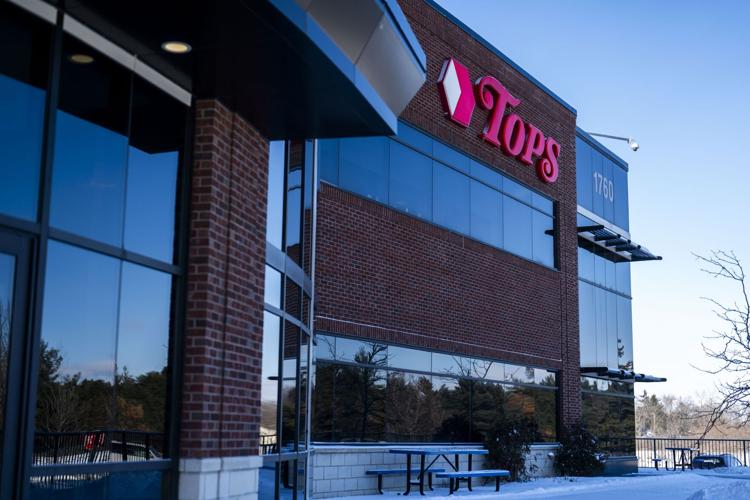
The Tops headquarters building.
Q: What's on your radar in the future?
A: I think you'll see more different sorts of bar code experiences on price tags. So if you're a customer, you can use your smartphone to scan the code and learn more about the products.
We'll also have a mobile app refresh with greater personalization tied to (customers') loyalty ID. So the products they like most will show up in the promotions at the top, so they'll be more apt to understand what's going to drive value for that individual customer.
There'll also be AI-powered product recommendations based on their purchase history and their digital identity. Perhaps in the future, we might do a mobile wallet integration with our loyalty card so it can be resident in their phone, which allows us to do different things.
We'll take a look at digital nutrition and allergy ingredient tools so if you're allergic to certain types of food, you know quickly on your mobile app what is acceptable to you, as well as more rich digital nutritional information.
We'll also add in the mobile app refresh in the future advanced ordering for deli and prepared foods, for example, so that as you're shopping, you don't have to wait in line or take a number, and your foods will be ready when you've done your shop.
We're going to use a lot of AI and generative AI in the future. So think of solutions like, helping you determine very quickly what you need to buy if you wanted to make a casserole for dinner. It would give you the ingredients specifically that you would need to purchase, and perhaps add it to your shopping list on your mobile app.
Conversely, suggesting what you can make with different types of ingredients that you have at home, which maybe you haven't thought of. We'll also use computer vision in the future to capture products that are sitting in your refrigerator or freezer or pantry, and then use that as a baseline as to what you typically buy and add it to your regular list.
Other creative things we might do in the future is taking an image of a restaurant menu or prepared food item and it'll automatically tell you the ingredients that are in it and what you need to buy, and maybe even give you a recipe on how to do it and add it to your cart.
I know we're going to strengthen our Wi-Fi in stores so we can have more interactive experiences with our customers. And I think in the future, we'll take a closer look at smart carts.