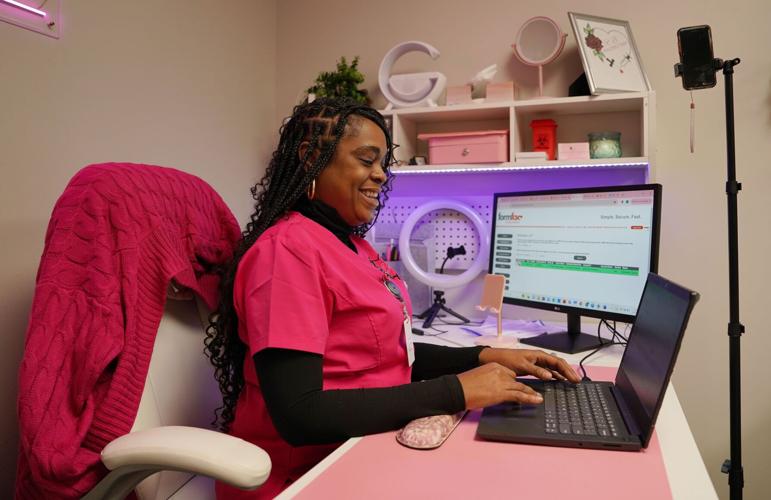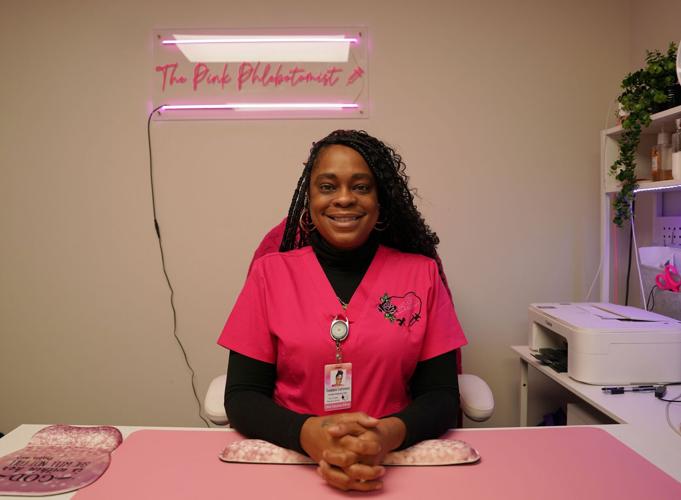

Candace Lattimore is the owner of Rosia B. Mobile Phlebotomy Services, which serves Western New York.
Candace Lattimore dresses in a pink uniform, carries a pink medical kit and wears pink gloves. The mobile phlebotomist uses pink tourniquets and, when the blood draw is done, she applies a pink bandage.

“You’re not just a number or paycheck to me,” says Candace Lattimore, owner of Rosia B. Mobile Phlebotomy Service.
The reason is simple, Lattimore says: Pink is a natural calming color, and she aims to keep her patients as comfortable as possible during what can be an uncomfortable, but necessary, moment.
“It’s a lot more comfortable for them,” said Lattimore, owner of Rosia B. Mobile Phlebotomy Services. “I’m coming into their home, making them a little more relaxed.”
More and more, health care services are being delivered right to the home, fitting into an ongoing trend of meeting patients where they are and ensuring people are getting the crucial preventive services they need to stave off larger, and more expensive, health problems that can worsen if left untreated and undiagnosed.
People are also reading…
You see it everywhere. For instance, Willa Arnet, a Buffalo nurse practitioner, is partnering with Amherst-based health plan Independent Health on a pilot program geared toward reaching the insurer’s Medicaid members who hadn’t been seeing a doctor.
“You’ve got to meet the patients where they are and understand what their unique needs are,” said Independent Health CEO Michael W. Cropp. “It’s part of this transition from a sort of organizational or facility-centered model of care to a more person-centered community-based model of care.”

Through at-home medical visits, Willa Arnet is meeting patients where they are, learning about their home environments and eliminating barriers that have left some to go without health care.
Building trust with patients
Lattimore is convinced some of her patients would go without needed bloodwork if she was unable to come right to them. Some people don’t have the time to visit a clinic for lab work, she noted, and others struggle with transportation, including the elderly.
In some cases, Lattimore said, she’s the only person that patients may see all day or all week. So she spends time with them and starts by introducing herself, explaining how long she’s been a phlebotomist and asking what arm works best for them. She leaves them a business card, and she makes a follow-up phone call to them afterward to make sure they’re doing OK and not experiencing any pain or swelling.
“I let them know this is a relationship,” said Lattimore, who launched her business last year. “You’re not just a number or paycheck to me.”
It’s how Lattimore says she’s able to build trust with patients.
To health care expert Larry Zielinski, the rise of some of these home-based services is “reminiscent of the old country doctor who used to spend his day making house calls.”
This model, in particular, is often being used for treating patients with chronic diseases, fitting into a larger movement in health care toward managing the total cost of care for certain populations and aiming to prevent costly hospital readmissions.
As local examples, Zielinski mentioned Independent Health’s Care for You model, Highmark Blue Cross Blue Shield of Western New York’s Care at Home program and his Primary Care Independent Physician Association’s partnership with Honest Medical Group. n class=”print_trim”>

Independent Health is offering the program, called "Care for You," to its Medicare Advantage members with chronically complex medical conditions.
A grandmother’s influence
Sitting in her West Seneca office – which, yes, is decked out in pink – Lattimore thinks back to her grandmother.
Lattimore’s mother was a single parent, which meant the family’s elders helped raised her, including her grandmother, Rosia Brown.
When Lattimore was a child, she noticed her grandmother had nurses come in to take care of her. But as Lattimore got older, she started stepping in to help care for her grandmother.
“So it kind of put me in the health care field before I actually realized this was the field that I wanted to be in,” Lattimore said.
From her grandmother, Lattimore said she learned compassion, empathy, sympathy and patience.
“She kind of steered me in this way and because she was so instrumental in just helping me become the person I am, I felt like this is the best way to honor her by naming my company after her,” she said.

Rosia B. Mobile Phlebotomy Services LLC owner Candace Lattimore.
‘Where health care is going to be’Lattimore’s business serves all of Western New York and a little beyond. She said she’s been as far east as Rochester and as far south as 10 to 15 minutes outside of Erie, Pa.
Her business offers blood draw testing – as simple as A1C tests to measure average blood sugar levels to more specialized tests such as those for organ donor or gender testing – as well as many other tests, including drug screens.
Lattimore said anyone can call to make an appointment, though her business runs on self-pay and doesn’t currently accept health insurance.
She noted it’s difficult to get in with the insurance companies when just starting out as a small business, but she described her rates as affordable. On her website, for instance, a routine draw – a blood test ordered by a medical professional – runs around $65.

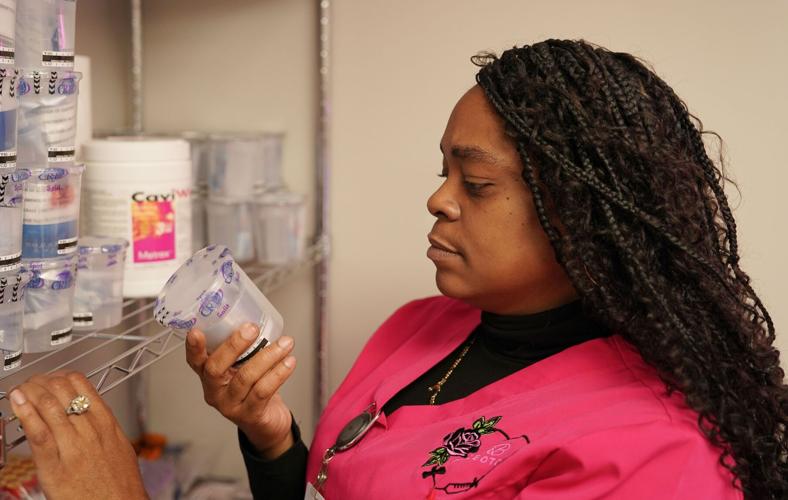
Rosia B. Mobile Phlebotomy Services LLC owner Candace Lattimore analyzes a testing bottle from a shelf in her office.
Moving forward, Lattimore said it’s her hope to develop a partnership with a laboratory that can send her to visit patients who can’t make it in to a medical office.
And while she’s currently a staff of one, she said she has seven phlebotomists on standby who she can call on as business picks up.
“I definitely have a network that I’ve built, because I am one determined cookie,” said Lattimore, also a CPR instructor with a goal to certify 500 youths this year. “If I said I’m going to do it, I’m going to do it.”
As she looks ahead, Lattimore said she’s confident work like hers is here to stay and that there will be more mobile phlebotomists in the years ahead – and not just to serve homebound patients.
“This is definitely where health care is going to be,” she said.
Jon Harris can be reached at 716-849-3482 or jharris@buffnews.com. Follow him on Twitter at @ByJonHarris.

Jon Harris
Healthcare reporter