
Medical technology advancements and innovations usually have a way of trickling down to low-income and underserved communities last.
But not this time.
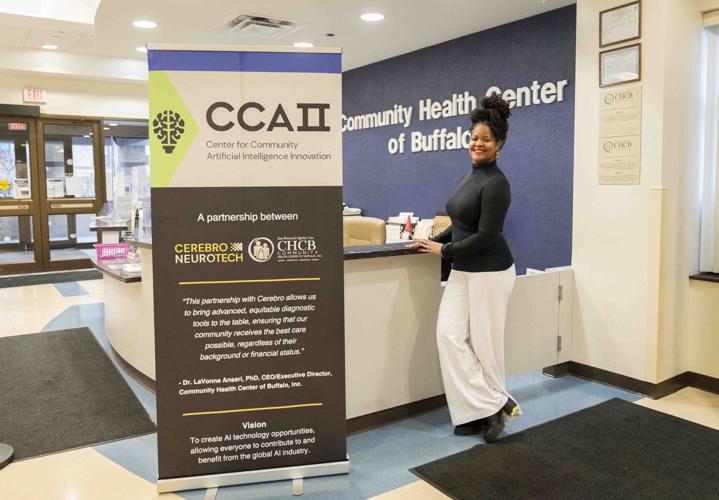
Community Health Center of Buffalo, which provides health care to underserved populations, has partnered with Cerebro NeuroTech, a Buffalo-based company that specializes in using artificial intelligence and computing technologies to rapidly detect traumatic brain injuries, neurodegenerative conditions and cognitive impairments.
The partnership, which could change how quickly and accurately traumatic brain injuries and sports-related concussions can be detected and treated, also aims to tackle health inequities and put underserved communities at the forefront of benefitting from cutting-edge technology.
“It really just shows the strategy, the innovation, the mindset comes from many different pockets of communities and not just, you know, Silicon Valley or New York City,” said Paolo Alejandro Catilo, CEO and chief engineer of Cerebro NeuroTech.
People are also reading…

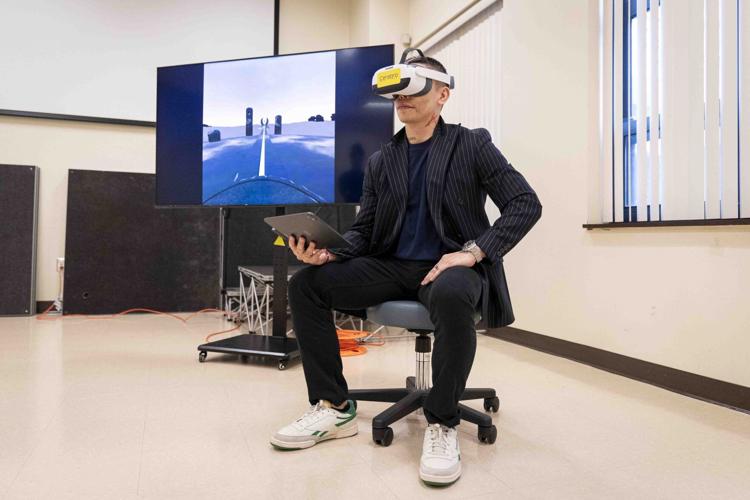
Paolo Alejandro Catilo demonstrates the Pico Neo 3i to help diagnose concussions at the Community Health Center of Buffalo.
Each year, traumatic brain injuries account for more than 1.5 million emergency visits across the country, and underserved communities often experience delayed diagnoses and poorer outcomes from those injuries.
Community Health Center of Buffalo cited research that shows low-income and Black, Indigenous and people of color populations are at least 33% more likely to experience long-term disabilities due to untreated traumatic brain injuries or sports-related concussions.
How it works
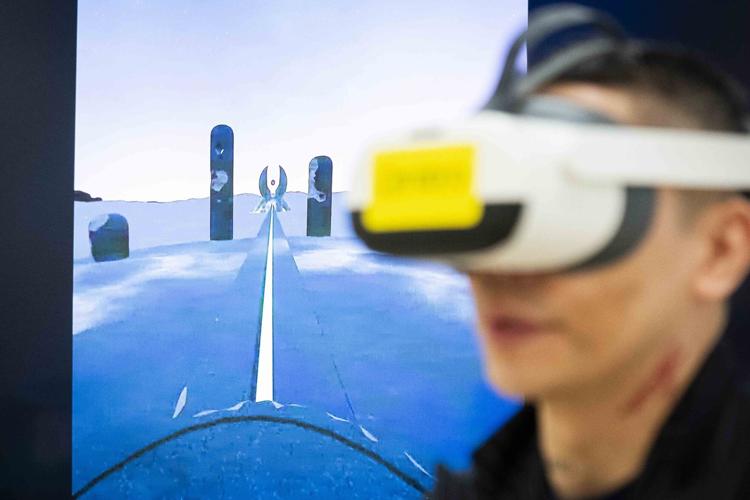
Once the patient puts on the Cerebro NeuroTech headset, they are immersed in a gamified, virtual reality-like world that starts with an eye calibration test.
From there, patients use their eyes to follow specific orbs within the virtual reality world. In just 60 seconds, Cerebro NeuroTech is capturing 200,000 data points on how the patient is cognitively functioning and how their eyes are processing and looking at specific virtual reality environments.
“In that 60 seconds, we’re able to deduce and understand the specific symptoms of a traumatic brain injury or a head trauma or sports-related concussions through how your eyes are functioning,” Catilo said.

Once patients put on the Cerebro NeuroTech headset, they are immersed in a gamified, virtual reality-like world that starts with an eye calibration test.
The technology provides a new tool for clinicians at Community Health Center of Buffalo.
Typically, assessing someone with a possible concussion includes interviewing and asking them questions about their symptoms along with an eye-tracking test, in which a physician asks the patient to use their eyes to follow the doctor’s finger. But that kind of screening, Catilo said, can be subjective.
“What is a traumatic brain injury? What is a concussion? It’s cellular injury,” said Dr. Kenyani Davis, chief medical officer of Community Health Center of Buffalo. “You can’t see cellular injury, so this gives you the ability to look at cellular injury through other mechanisms, and I think that’s what piques my interest in our partnership.”
Catilo added: “It gives the clinician a lot of confidence.”
That’s what Catilo envisioned when the company was founded in 2022.
It started with a slip
While he was running a medical software company in Switzerland, Catilo was making breakfast for one of his three sons when his son slipped off the stool.
He stood his son up and, without being a doctor, knew something was wrong. He thought of a call he had gotten previously that his son had collided with another kid on the playground, and he wondered about the impact from that incident.

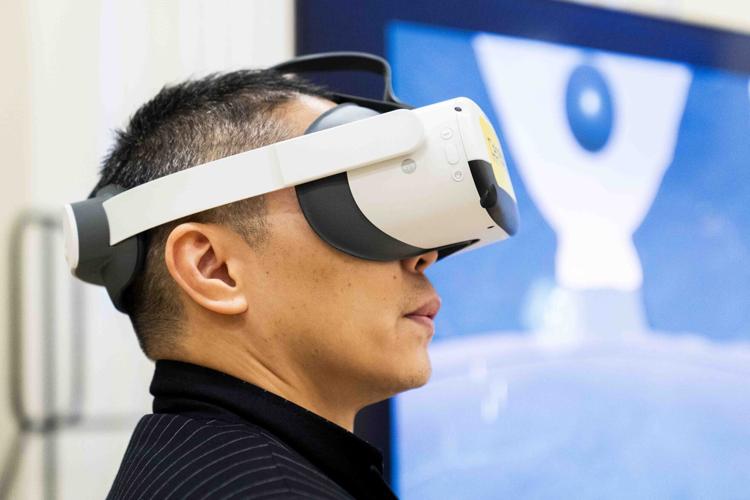
Paolo Alejandro Catilo said his company is committed to helping communities that have been historically marginalized by the health care industry.
Catilo didn’t know what to do. He felt paralyzed in that moment.
But that situation also led to a thought: Could he build something that could help quickly assess a patient’s cognitive trauma?
“Until Cerebro, the only way to do that is to get to an MRI machine,” he said. “We know that MRI machines, these CT scans, are at the end of the protocol. Most patients don’t get there. So that kind of thought process of building something for that acute application was something that I obsessed over for the last two years. And here it is, we built it.”
While Catilo said Cerebro NeuroTech is now headquartered in Buffalo, the company also has offices in Washington, D.C., and Birmingham, Ala. He said Blue Cross and Blue Shield of Alabama invested in Cerebro NeuroTech in its pre-seed round, which helped the company with research and application. Today, the company’s 10 employees are working and building relationships with organizations like Community Health Center of Buffalo.
More data, more accuracy
Catilo said the collaboration is in the “early stage” of patient data acquisition and extracting training data for its technology and machine learning. In addition to Community Health Center of Buffalo, the company also is working with hospital systems in Birmingham and in Washington, D.C.
“Our goal this year is to amass a patient body size of about 3,000 patients,” Catilo said. “So thus far, we’ve had already about 250 and these data sets are leading to some of our models showing high-sensitivity, high-specificity accuracies for detection much higher than anything else on the market today.”
Catilo said his company is committed to ensuring communities that have been historically marginalized by the health care industry – such as populations within Buffalo, Birmingham and Washington, D.C. – have access to innovative technologies.

Dr. Kenyani Davis at the Community Health Center of Buffalo. She can see Cerebro NeuroTech’s diagnostics being useful for the general population, including police officers and firefighters.
Davis, the chief medical officer of Community Health Center of Buffalo, said that while sports-related concussions often get the headlines, she can see Cerebro NeuroTech’s diagnostics being useful for the general population, including police officers and firefighters. She thought of a past patient of hers, an exterminator, who would crawl through shafts and attics and always hit his head on beams during his work.
And when those patients come in, they don’t think about the head trauma – but they describe symptoms such as trouble sleeping, headaches, depression and irritability.
As she thinks about the partnership with Cerebro NeuroTech, Davis sees it as an example of investing in the community and in its health outcomes.
“I’ve changed my verbiage from underserved, because there are services – we’re disinvested,” she said. “If we want to stop being the downstream entity of poor outcomes, then we invest and find different ways to invest. It’s not just through money. You teach a man how to fish. And I think that’s what we’re doing by anchoring Cerebro within the community and within the health center is we’re teaching the community to fish.”
Jon Harris can be reached at 716-849-3482 or jharris@buffnews.com. Follow him on X at @ByJonHarris.

Jon Harris
Healthcare reporter