
Banks like M&T and KeyBank see lots of potential in artificial intelligence, but they also are keeping the technology's use in check.
While AI can make their operations run more efficiently, banks say maintaining oversight is essential.
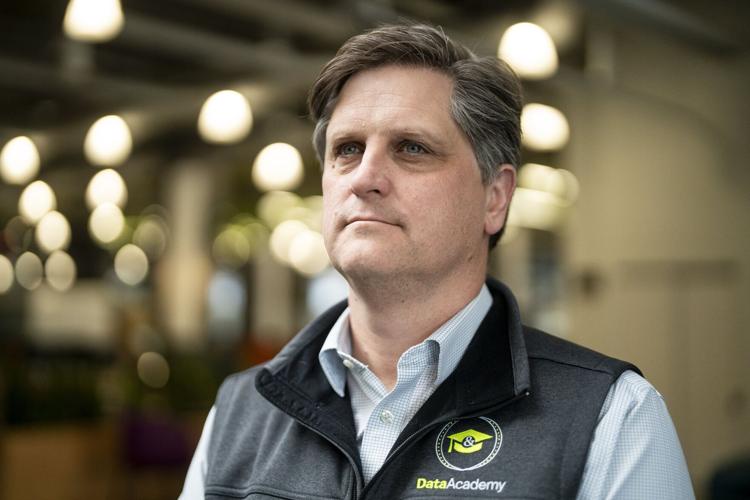
"You keep the human in the loop, because the human has to be accountable for the final product," said Andrew Foster, M&T's chief data officer.

"You keep the human in the loop, because the human has to be accountable for the final product," said Andrew Foster, M&T's chief data officer.
Amy Brady, Key's chief information officer, takes a similar view.
"I think in our industry, where trust is so important, you have lots of opportunities to earn trust − you can lose it very quickly," she said.
There's no denying AI's impact as disruptive technology. Banks, like so many other industries, are embracing AI, while recognizing the need for putting guardrails in place.
People are also reading…
M&T and Key have invested heavily in their digital capabilities. But when it comes to deploying AI, both Foster and Brady describe the technology as playing a supporting role, rather than making decisions for customers and removing humans from the equation.
"When it comes to adding generative AI, the large language models, it absolutely opens up additional opportunities for all of us to create efficiencies and speed and productivity across the board," Brady said.
Brady said she looks at generative AI as just another tool in the toolbox on the spectrum of AI.
"I think all of those things combined allow us, on the back office, to really look at processes that we can automate even more than we have already, make it easier for our employees to do their jobs, so that they're not spending so much time analyzing things that we can provide a starter for them," she said.
AI − especially generative AI − is a front-burner topic in financial services, commanding attention and dollars. A newly released report by the World Economic Forum and Accenture said financial services firms spent $35 billion on AI in 2023, with projected investments to reach $97 billion by 2027.
With those big investments come significant challenges.
"Never before has the industry attempted to reinvent itself, its practices and its offerings so extensively at such a rapid pace," the report said.
There are a lot of expectations riding on getting use of the technology right. About 70% of financial services executives believe AI will directly contribute to revenue growth in the coming years.
Both Brady and Foster point out that banks have used elements of AI in their operations for years. But new, powerful opportunities are emerging, particularly on the generative AI front.
M&T launched a multipronged strategy to assess AI and determine how to use it, Foster said. That strategy revolves around setting controls and governance; educating employees about using the technology; and experimenting to see what works best.
"Everything we're looking at is: How can we return time to the employee?" he said.
A simple example is using AI to transcribe the notes of a meeting among employees and generate a summary. An employee still reads what's produced to ensure it's accurate, and makes changes where necessary, but it's still a big time saver.
Foster cites another beneficial use, related to his own work. He conducted an internal assessment that generated 650 comments. Instead of reading every comment, as in the past, he used AI to provide tonal analysis, asking for the most positive and negative areas in the comments.
"Now I'm going to read the comments from that particular area," he said.
AI can help the bank's workers manage a wave of information they must sort through, as that volume continues to grow, he said.
"You need a way to digest what is relevant and you need a way to help you make decisions," Foster said.
M&T is a longtime customer of nCino, a firm that serves the financial services industry. Last year, M&T said it was integrating nCino's continuous credit monitoring solution into its operations, which uses Rich Data Co.'s AI decisioning platform.
According to nCino, the platform will give M&T better insights into cash flow health, credit risk and lending opportunities at the customer and portfolio levels.
"This will enable M&T to detect more early warning signs and have access to additional data when making decisions throughout the customer relationship life cycle," nCino said at the time.
M&T is keeping its use of AI restricted to certain areas, Foster said. "Our focus is not going to the customer-facing side, because you need to learn and mature the technology."
Meanwhile, M&T is striving to keep its employees' tech skills current, through its Data Academy. In 2024, over 1,000 employees received different forms of training through the academy, ranging from introduction to data to advanced data analytics.
"It's a way of investing in the human capital of the people at M&T, so you can consistently uplift their skill sets," Foster said. "AI is just another flavor of that mission."
At Key, Brady said employees have shown interest in learning more about AI, and how it could impact their jobs.

"I think in our industry, where trust is so important, you have lots of opportunities to earn trust − you can lose it very quickly," said Amy Brady, chief information officer for KeyBank.
Key employees are allotted time each quarter for training, and last year, Brady challenged the employees she oversees to take a course in the foundations of generative AI.
"I wanted them to see the art of the possible: How could these tools help them in their job, and how do they prepare themselves for change?" she said.
By the end of 2024, over 90% of those employees − including operations, tech and risk management − had taken the course.
Like M&T, Key is experimenting with different uses of AI, to see what delivers the best results.
"We have between 20 and 30 pilots going on in various parts of our company, mainly middle and back office, mainly focused on how do we continue to drive productivity, efficiency, effectiveness of our processes," Brady said.
While AI grows in prominence in financial services, Brady said Key is keeping a close eye on the technology and what the bank gets from it.
Key receives plenty of pitches for different models from vendors and third-party consultants. An executive review council at the bank evaluates those pitches, to compare the cost of completing a transaction with the value Key receives.
"If you're not careful, some of these things can cost you a lot of money and you may not pull through that business value," Brady said. "We're being very disciplined on that."