
It was a frigid day in early January, and the heat wasn’t working in the Buffalo building that houses the Niagara University Biomedical Research Institute.
But even that wasn’t enough to chill the enthusiasm of Mary McCourt, a scientist and chemistry professor who directs the institute on the Buffalo Niagara Medical Campus.
“This is where the excitement is,” said McCourt. “For us to come from Niagara, from Lewiston, to be down here, to be a participant in that, it’s really important – not just for the work, but for the students that we have to see the vision of what an entire ecosystem of drug development therapeutics takes.”
McCourt’s new lab became fully functional in January 2024 in a building that long ago housed a lab for the Hauptman-Woodward Research Institute, where McCourt once worked as a research scientist before joining Niagara in 1999.
People are also reading…

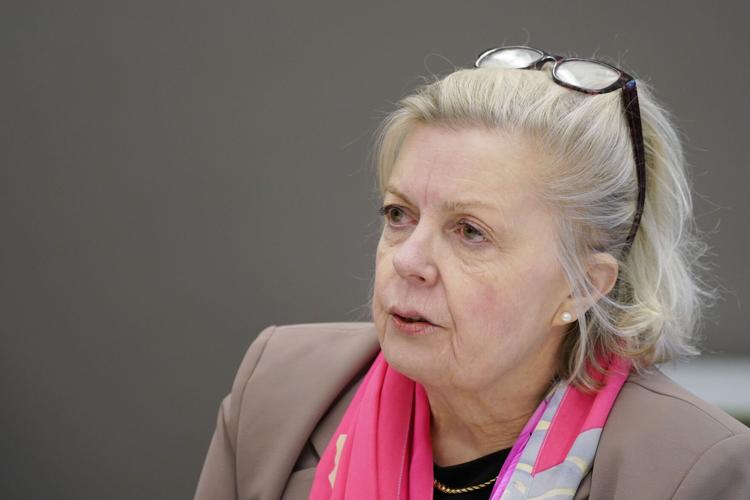
Dr. Mary McCourt, the Michael J., '60 and Aimee Rusinko Kakos Endowed Chair of Chemistry at Niagara University, leads the Niagara University Biomedical Research Institute on the Buffalo Niagara Medical Campus.
In her lab, McCourt is working to develop a next-generation antiviral therapy while training – and working alongside – the next generation of scientists, who are currently Niagara undergraduates.
That lab’s work revolves around a $261,500 award the university received last summer from the state Biodefense Commercialization Fund. Niagara, which was one of three academic institutions to receive awards, is formulating an antiviral therapeutic using Cholestosome technology, a molecule delivery system developed by McCourt that holds promise for targeted drug delivery.
The project aims to use Cholestosome technology to circumvent the body’s regulation of zinc, allowing intracellular concentrations capable of causing a general antiviral response. Such a development could boost patient outcomes in response to pathogen infections while increasing preparedness for future viral outbreaks or pandemics.

The lab will be led by professor Mary McCourt, an award-winning researcher who has taught at Niagara since 1999.
“I’ve invented a technology that allows us to deliver things into cells or to deliver things orally that have never been able to be done before, and so the specific focus of the work right now is on biodefense,” said McCourt.
“What we’re trying to do is we’re trying to develop a general antiviral therapeutic that we don’t need to know then what the virus itself is,” she added. “All viruses need our cells to propagate. So what we’re trying to do is we’re using our technology to develop a therapeutic, which will get inside our cells and then stop the virus from having its ability to replicate. If we do that, then we give ourselves a fighting chance when the next pandemic comes.”
McCourt, an Amherst resident who grew up in Western New York and holds three degrees from the University at Buffalo, is driven by the work of finding ways to deliver drugs more effectively, particularly to the brain. But, she said, part of what makes the work so “interesting and exciting” is her interactions with her students.
Q: What did you want to be when you were growing up?
A: My brother had a brain tumor when he was 5, and it has influenced me my entire life. He passed away when he was in his 20s, but I always wanted to be somebody who could figure out how to get drugs into the brain. I didn’t know what that meant at that time, but that was what I thought. I think I thought it would be like a physician, but I always liked science, always liked math.
I was older than him. His life has had an incredible impact on me, to figure those problems out.

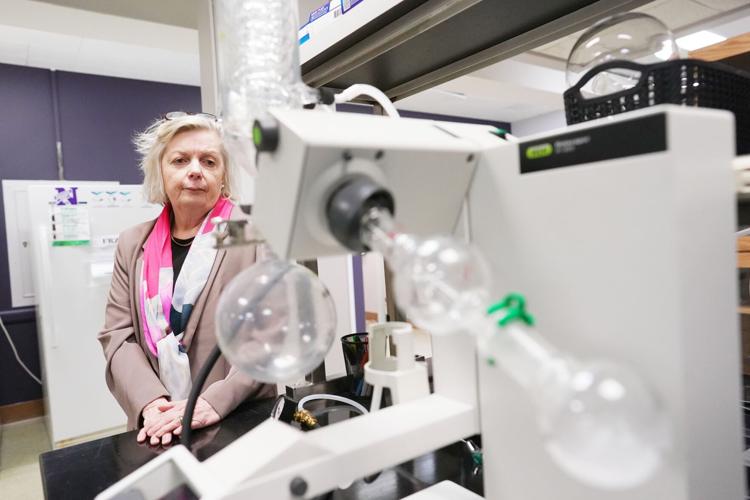
Dr. Mary McCourt directs the Niagara University Biomedical Research Institute on the Buffalo Niagara Medical Campus. She is working on a biodefense project that could increase preparedness for future viral outbreaks or pandemics.
Q: How old were you when he was 5?
A: I was like 7. But the event, that whole life and how it affected families and how it affected all of us defined who I am.
Q: What do you like about chemistry?
A: Don’t laugh when I say this. Chemistry and math to me are like beautiful pieces of art. They really are. They’re like puzzles and beautiful pieces of art.
I actually am not really an experimentalist. I’m a theoretician, I’m a molecular modeler person, and that’s how I designed this whole system is on a computer. I designed it all on a computer, but it’s really about solving problems. To me, it’s just really beautiful, and then when I tell that to students, they all look at me like I’ve lost it.
Q: Did the experience of working at Hauptman-Woodward, and alongside Herbert Hauptman, mold your career, as well?
A: Absolutely. These scientists were just unbelievable. They were just amazing people and scientists. What I tell the students: What I learned from working here – I was a computational modeler, and he was the crystallographer, he was the biology person – science problems are solved by integrating a whole bunch of disciplines. And you don’t work in a silo. You work with a lot of different kinds of people. This was an amazing place to be.
Q: Can you explain the work currently going on in your lab?
A: What we’re trying to do here is we’re trying to take our technology and use a really simple molecule like zinc. We all know we’re supposed to take zinc to be healthy, right? But the zinc doesn’t get inside the cells.

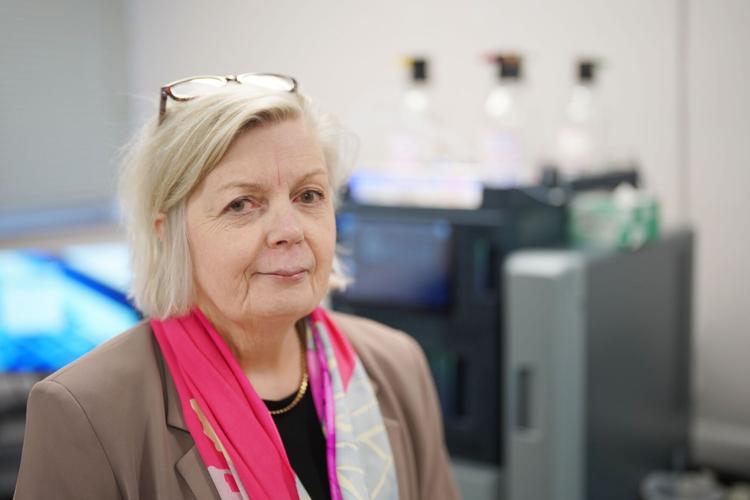
“Chemistry and math to me are like beautiful pieces of art,” says Dr. Mary McCourt, in the Niagara University Biomedical Research Institute on the Buffalo Niagara Medical Campus.
So what we’re trying to do is, our technology will deliver the zinc into the cells. It’s all that process of making it and analyzing and getting into the cells and figuring out, does it kill the virus? Does it not kill the virus? How much more should we use?
That’s what’s happening here right now. That’s what biodefense has asked us to do, is to figure out, can this really be used to treat a number of different kinds of things? And that’s the general nature of the work.
Q: Is it uncommon for undergraduates to get the kinds of hands-on experience they get in your lab?
A: It’s not completely common. Sometimes people talk about that they have an undergraduate research experience. But what our students do, they’re actually doing it. When they leave here, no matter what they do, they can go directly into a lab. Students will be hired directly out of graduation.
When I interview people, I want people to be able to do something for me. What can you do for this group? And our students can do things, and they also understand how to solve problems.

The first honoree is chemistry professor Mary McCourt, a Ph.D. scientist whose groundbreaking work on drug delivery technology is poised to transform the pharmaceutical industry.
I want them to realize the power of the science, the power that they have to effect change, the power that they have to create a new dynamic of things. They’re very efficiently trained as scientists, but also that message of what they can do, what they can create, and how they can really solve problems.
Q: What do you hope comes out of this lab in the future?
A: Our objective is commercialization. The first component that we’re looking at is the zinc. We are looking to develop partnerships with industry to find opportunities to commercialize the technology. And that really is sort of my goal, my goal is to take some component of this technology.
One of our projects that we’re just developing now is lead. It’s about removing lead. So we take our technology, our Cholestosome, and we put chelators in them, and we deliver it to neural cells that have been treated with lead, and we’re able to suck out the lead.
When we treat kids or whatever with chelators, when they have lead poisoning, it doesn’t take the lead out of their brain. It just takes it out of the bloodstream.
And so the damage that’s done neurologically is there, it doesn’t go away. And so those kinds of things … commercializing something like that, it would be very, very powerful.
Jon Harris can be reached at 716-849-3482 or jharris@buffnews.com. Follow him on X at @ByJonHarris.

Jon Harris
Health care reporter